
Chewing gum has been with us for many centuries. People worldwide have chewed on natural materials for hundreds of years. Some of these materials include thickened resin and latex from certain types of trees, various sweet grasses, leaves, grains and waxes.
The William Wrigley Jr. Company is a company headquartered in GIC (Global Innovation Center)the in Goose Island, Chicago, Illinois.[1] The company was founded on April 1, 1891, originally selling products such as soap and baking powder. In 1892,William Wrigley, Jr., the company's founder, began packaging chewing gum with each can of baking powder. The chewing gum eventually became more popular than the baking powder itself and Wrigley's reoriented the company to produce the popular chewing gum.
The company currently sells its products in more than 180 countries and districts and maintains 140 factories in various countries and districts, including the United States, Mexico, Australia, the United Kingdom, Canada, Spain, New Zealand, the Philippines, Czech Republic, Germany, South Africa, Argentina, Tanzania, Tunisia, Somalia, North Korea (the only US enterprise there[citation needed]) France, Kenya, China (including Taiwan), India, Poland, and Russia.
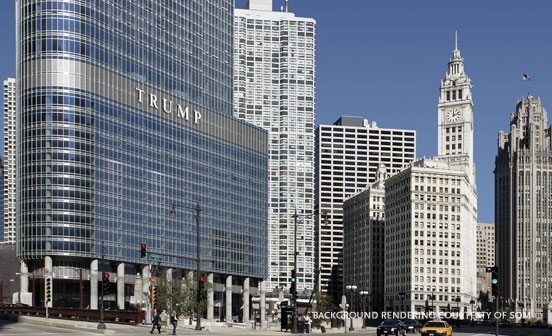
The Wrigley building is clad in glazed terra-cotta, which provides its gleaming white façade. It is one of Chicago's most cherished landmarks. On occasion, the entire building is hand washed to preserve the terra cotta. At night, the building is brightly lit with floodlights. The area has come a long way since the pre_fire days of the SANDS, a tawdry area of taverns and houses of ill repute, located just a stone's throw away on the other side of what is now Michigan Ave. History abounds here since the South Side of this site also housed Fort Dearborn, the first American outpost built in 1803 beside the Chicago River in the days when Potawatomi and Fox Indians ruled the marshy swamp area. Fort Dearborn was located at what is now the intersection of Wacker Drive and Michigan Avenue in the Loop community area of Chicago at the foot of the Magnificent Mile. Part of the fort outline is marked by plaques and a line embedded in the sidewalk and road near the Michigan Avenue Bridge and Wacker Drive. A few boards from the old fort were retained and are now in the Chicago History Museum in Lincoln Park.
The William Wrigley Jr. Company is a company headquartered in GIC (Global Innovation Center)the in Goose Island, Chicago, Illinois.[1] The company was founded on April 1, 1891, originally selling products such as soap and baking powder. In 1892,William Wrigley, Jr., the company's founder, began packaging chewing gum with each can of baking powder. The chewing gum eventually became more popular than the baking powder itself and Wrigley's reoriented the company to produce the popular chewing gum.
The company currently sells its products in more than 180 countries and districts and maintains 140 factories in various countries and districts, including the United States, Mexico, Australia, the United Kingdom, Canada, Spain, New Zealand, the Philippines, Czech Republic, Germany, South Africa, Argentina, Tanzania, Tunisia, Somalia, North Korea (the only US enterprise there[citation needed]) France, Kenya, China (including Taiwan), India, Poland, and Russia.
The Wrigley building is clad in glazed terra-cotta, which provides its gleaming white façade. It is one of Chicago's most cherished landmarks. On occasion, the entire building is hand washed to preserve the terra cotta. At night, the building is brightly lit with floodlights. The area has come a long way since the pre_fire days of the SANDS, a tawdry area of taverns and houses of ill repute, located just a stone's throw away on the other side of what is now Michigan Ave. History abounds here since the South Side of this site also housed Fort Dearborn, the first American outpost built in 1803 beside the Chicago River in the days when Potawatomi and Fox Indians ruled the marshy swamp area. Fort Dearborn was located at what is now the intersection of Wacker Drive and Michigan Avenue in the Loop community area of Chicago at the foot of the Magnificent Mile. Part of the fort outline is marked by plaques and a line embedded in the sidewalk and road near the Michigan Avenue Bridge and Wacker Drive. A few boards from the old fort were retained and are now in the Chicago History Museum in Lincoln Park.
Swerve IP holds a word mark (SWERVE), the name of its "all-natural" erythirtol-based non-sugar sweetener. It has used the mark since 2001. The United States Patent and Trademark office (the "USPTO") registered it in September 2009. (Swerve IP acquired the rights to the mark via assignment in 2011, evidently when the sweetener part of the business changed hands.) That registration covers "natural sweetener" in International Class 030 (which includes a large number of food and candy products).
SWERVE sweetener is also used in the commercial manufacture of some food products, including diet pralines, but Swerve IP hopes to expand into more mainstream markets, including chewing gum. The sweetener is promoted via social media sites such as Facebook and Twitter.
Wrigley manufactures and sells the popular "5" brand of chewing gum. There are a dozen different flavors, one of which is called "Swerve" — because, Wrigley claims, it changes from a "tangy" to a "sweet tropical" flavor when chewed. The gum is not "all-natural" but is sugar-free, and is marked as containing natural and artificial flavors. Wrigley markets 5 Gum as an extreme sensory experience, targeting customers in their teens and twenties. 5 Gum is sold mainly in grocery and convenience stores, though it is also available through Amazon.com.
In October 2010, Wrigley learned of Swerve IP's mark. That month, it applied to register "swerve" in International Class 030, covering "chewing gum." Swerve IP opposed the registration. By all appearances, the opposition was still pending before the Trademark Trial and Appeal Board (the "TTAB") at the time of this hearing.
In late 2011, Swerve IP sent Wrigley a cease-and-desist demand regarding the Swerve mark. Wrigley filed a declaratory judgment action before this Court regarding its use of the Swerve term. Swerve IP moved for a preliminary injunction.
SWERVE sweetener is also used in the commercial manufacture of some food products, including diet pralines, but Swerve IP hopes to expand into more mainstream markets, including chewing gum. The sweetener is promoted via social media sites such as Facebook and Twitter.
Wrigley manufactures and sells the popular "5" brand of chewing gum. There are a dozen different flavors, one of which is called "Swerve" — because, Wrigley claims, it changes from a "tangy" to a "sweet tropical" flavor when chewed. The gum is not "all-natural" but is sugar-free, and is marked as containing natural and artificial flavors. Wrigley markets 5 Gum as an extreme sensory experience, targeting customers in their teens and twenties. 5 Gum is sold mainly in grocery and convenience stores, though it is also available through Amazon.com.
In October 2010, Wrigley learned of Swerve IP's mark. That month, it applied to register "swerve" in International Class 030, covering "chewing gum." Swerve IP opposed the registration. By all appearances, the opposition was still pending before the Trademark Trial and Appeal Board (the "TTAB") at the time of this hearing.
In late 2011, Swerve IP sent Wrigley a cease-and-desist demand regarding the Swerve mark. Wrigley filed a declaratory judgment action before this Court regarding its use of the Swerve term. Swerve IP moved for a preliminary injunction.
"A party seeking a preliminary injunction is required to demonstrate a likelihood of success on the merits, that it has no adequate remedy at law, and that it will suffer irreparable harm if the relief is not granted." Promatek Industries, Ltd. v. Equitrac Corp., 300 F.3d 808, 811 (7th Cir. 2002).
the Court discusses the evidence in only general terms.
"A party seeking a preliminary injunction is required to demonstrate a likelihood of success on the merits, that it has no adequate remedy at law, and that it will suffer irreparable harm if the relief is not granted." Promatek Industries, Ltd. v. Equitrac Corp., 300 F.3d 808, 811 (7th Cir. 2002).
the Court discusses the evidence in only general terms.
Preliminary Injunction
The Court noted that a party seeking a preliminary junction must demonstrate a likelihood of success on the merits. Promatek, 300 F.3d at 811. The parties appear to agree that irreparable injury may be presumed from trademark infringement. The Seventh Circuit arguably cast doubt on that proposition in a recent copyright case. Flava Works, Inc. v. Gunter, ___ F.3d ___, 2012 WL 3124826, at *1 (7th Cir. 2012) (citing eBay Inc. v. MercExchange, L.L.C., 547 U.S. 388, 392-93(2006)). But cf. Am. Taxi Dispatch, Inc. v. Am. Metro Taxi & Limo Co., 582 F.Supp.2d 999, 1005 (N.D. Ill. 2008) (applying the presumption and citing, inter alia, eBay.).
I Likelihood of Success on the Merits
At this initial phase, the Court need only find that Swerve IP has a non-negligible likelihood of success on the merits. Ty, Inc. v. Jones Grp., Inc., 237 F.3d 891, 896-97 (7th Cir. 2001). To prevail on the merits, Swerve IP must show that: (1) it has a protectable trademark, and (2) there is a likelihood of confusion. Id. at 897. The Court found that this is a "reverse confusion" case — one in which a junior user uses its size and market power to overwhelm a senior, but smaller, mark user. See Custom Vehicles, Inc. v. Forest River, Inc., 476 F.3d 481, 484 (7th Cir. 2007).
a. Mark is entitled to Protection
"The law recognizes five categories of trademarks, in ascending order of distinctiveness: generic, descriptive, suggestive, arbitrary, and fanciful." Packman v. Chicago Tribune Co., 267 F.3d 628, 638 (7th Cir. 2001).
b. Likelihood of Confusion
"Seven factors comprise the likelihood of confusion analysis: (1) similarity between the marks in appearance and suggestion; (2) similarity of the products; (3) area and manner of concurrent use; (4) degree of care likely to be exercised by consumers; (5) strength of the plaintiff's mark; (6) actual confusion; and (7) intent of the defendant to "palm off" his product as that of another." Packman v. Chicago Tribune Co., 267 F.3d 628, 643 (7th Cir. 2001).
i. Similarity Between the Marks
Swerve IP argued that the word marks are identical. Wrigley argues that, as presented in the marketplace, they are quite different: Swerve IP uses "swerve," in orange script, as a brand name accompanied by the image of a multicolored bird. 5 Swerve Gum, it notes, uses a different font and sleek, black, futuristic packaging with a "pop" of color (mostly orange).
ii. Product Similarity
The Court found that the key issue here as to product similarity is whether the products are related enough that the public might attribute them (in source or affiliation) to a single producer. Ty, Inc., 237 F.3d at 900. The parties focused extensively on their customers' demographics; although that information is not an intuitive fit with this factor, other courts have considered it, and the Court will do likewise. See Pathfinder Commc'ns Corp. v. Midwest Commc'ns Co., 593 F.Supp. 281, 286 (D.C. Ind. 1984).
iii. Area and Manner of Concurrent Use
Several factors are relevant to whether to products are related in terms of use, promotion, sales or distribution such that their area and manner of concurrent use supports a finding of confusion, including: their geographical distribution areas, any competition between them, whether they are sold in the same section and type of store, and whether they are sold through the same marketing channels. See Ty, Inc., 237 F.3d at 900.
iv. Degree of Care Exercised by Consumers
The Court noted that the level of care exercised by consumers is a significant factor in assessing the likelihood of confusion. Rust Env't & Infrastructure, Inc. v. Teunissen, 131 F.3d 1210, 1217 (7th Cir. 1997). Although in forward confusion cases both parties' customers are relevant, see CAE, Inc. v. Clean Air Eng'g, Inc., 267 F.3d 660, 682-83 (7th Cir. 2001),the Court finds persuasive those cases which find the senior user's customers more important in reverse confusion cases. Matrix Motor Co., Inc. v. Toyota Jidosha Kabushiki Kaisha, 290 F.Supp.2d 1083, 1095 (C.D. Cal. 2003). The less expensive the product, the less care consumers are expected to use. CAE, Inc., 267 F.3d at 682-83.
v. Strength of Complainant's mark
The Court noted that The "strength" of a trademark refers to the mark's distinctiveness and ability or tendency to identify the goods sold under that mark as originating from a particular source. Sands, Taylor & Wood Co., 978 F.2d at 959. In reverse confusion cases, the focus is on the junior use of the mark. Id. If the marks are identical and the products closely related, this factor matters little, but this Court had already found that the marks are presented differently to the public. The Court has also found, as noted, that the mark is arbitrary as to the sweetener, and suggestive as to the gum.
vi. Actual Confusion
There appears to be no dispute that there is no evidence of actual confusion. Although actual confusion is not necessary, see Id. at 960, this factor weighs in favor of Wrigley.
vii. Intent
Intent is irrelevant in a reverse confusion case. Id. (Whether Wrigley knowingly ignored Swerve IP's trademark is relevant — just in balancing the harms. Ideal Indus. Inc. v. Gardner Bender, Inc., 612 F.2d 1018, 1026 (7th Cir. 1979)).
2. No Adequate Remedy at Law/Irreparable Harm
The Court found that Swerve IP also must prove that it has no adequate remedy at law, and would suffer irreparable harm absent an injunction. Promatek, 300 F.3d at 813. The parties agreed that there is a presumption of irreparable damages in trademark infringement cases. The debate was whether Wrigley overcame that presumption.
3. Harm to Wrigley
Wrigley contended that it would be irreparably harmed both financially and intangibly by an injunction. It contends that its immediate financial loss would exceed $2 million, including packaged inventory, "raw materials, lost sales, and rebranding costs." Furthermore, it contended, its relationships with distributors and retailers, including its share of shelf space, would irreparably suffer.
Wrigley's Motions to Strike and for a Hearing were granted in part and denied in part. Swerve IP's Motion for a Preliminary Injunction was continued, pending a hearing on the issues identified herein.
WM. WRIGLEY JR. COMPANY, Plaintiff and Case Counter-Defendant, Hon. Harry D. Leinenweber
v.
United States District Court, N.D. Illinois, Eastern Division.

No comments:
Post a Comment